Student and Teacher Spotlights
Explore stories from students and teachers highlighting their contributions, achievements, and experiences within the STEM community.
Student Spotlights
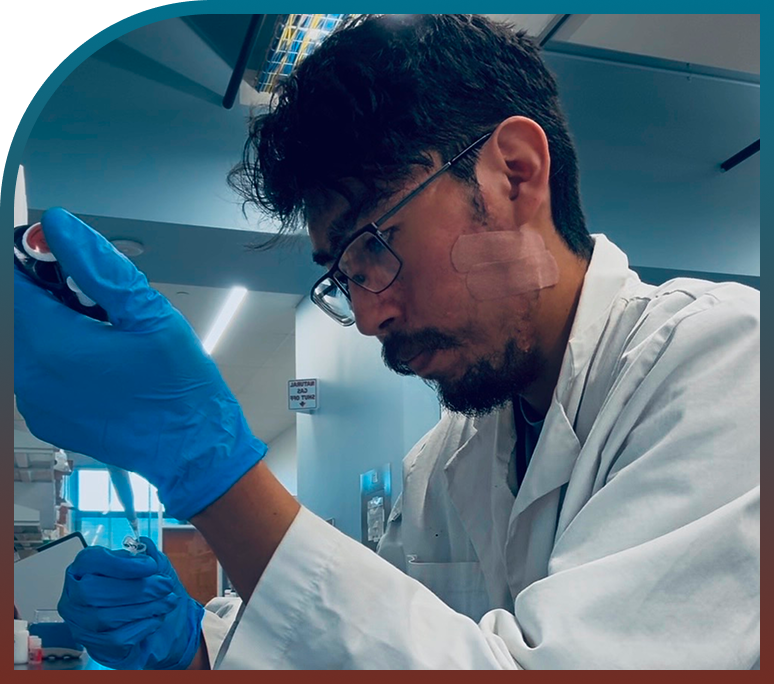
Thunder Crowshoe
Major: Biochemistry
Tell us a little about yourself. What hobbies do you enjoy in your free time?
In my free time, I enjoy playing video games, exercising, hunting, fishing, hiking, boxing, and practicing other martial arts. During the summer, I also enjoy grass dancing at powwows. I value listening to my uncle’s stories about the traditional governance systems of the Blackfoot Confederacy, particularly among the North Piegan and South Piegan, before colonization disrupted and changed those systems.
Since beginning my post-secondary education, I have also spent much of my free time preparing for future STEM courses by studying subjects such as mathematics and chemistry. I focus on developing practical skills, including dimensional analysis, mental estimation, logical reasoning, and problem-solving. These are some of the main things I practice whenever I have free time because I enjoy continually challenging myself and learning something new.
What is your major, and what drew you to this specific field of study?
My major is Biochemistry. I initially wanted to pursue a career in environmental science and conservation, but after being introduced to laboratory research, I quickly discovered how much I enjoyed the laboratory environment. I was drawn to the way laboratory work allows you to solve problems and then immediately apply your ideas through hands-on experimentation
I also became fascinated by the complex systems found in molecular biology and by the biochemical processes occurring within cells. Another aspect that drew me to the field was the amount of mathematics involved. I did not begin learning algebra until I entered university through the Indigenous Student Success Cohort. Building those essential mathematical foundations within one year was challenging, but my commitment to learning helped me continue progressing.
What has been your proudest academic or personal achievement so far?
One of my proudest personal achievements is the progress I have made in mathematics and science within only one year. I went from not knowing what a linear function or concentration was to learning how to calculate higher-order derivatives, construct Taylor polynomials, and solve practical laboratory calculations.
One of my proudest academic achievements is receiving an NSERC Undergraduate Student Research Award after completing my first-year courses at the University of Lethbridge. However, this achievement would not have been possible without the guidance and support of my mentors in the Department of Chemistry and Biochemistry and the Indigenous Student Success Program. Their encouragement helped me develop the confidence, knowledge, and laboratory experience needed to pursue researcopportunities.
How does your Indigenous background influence your approach to STEM?
From what I learned while growing up on the reserve, Blackfoot people emphasize the interconnectedness of the environment and all living beings. We have long understood that life is deeply connected and that we depend on one another for survival and well-being. The further I progress in my scientific education, the more I see that science strengthens and supports this perspective. It has shown me that biological and environmental systems are connected at every level, from entire ecosystems down to individual cells and molecules.
What motivated you to become involved in creating the University of Lethbridge AISES Chapter?
After coming to university and completing the Indigenous Student Success Cohort, I began spending most of my time in the science building while taking my first-year chemistry laboratories, mathematics courses, and other science classes. During that time, I would often notice only one or two other Indigenous students in my laboratories and lectures.
Because I was also socially awkward and still adjusting to university, I found it difficult to form study groups or find people with whom I could learn and work in the laboratory. I also felt that there was a lack of shared cultural understanding and experience. This motivated me to help establish an AISES chapter where Indigenous students in STEM could meet one another, build friendships, study together, share experiences, and feel supported within the university’s science community.
